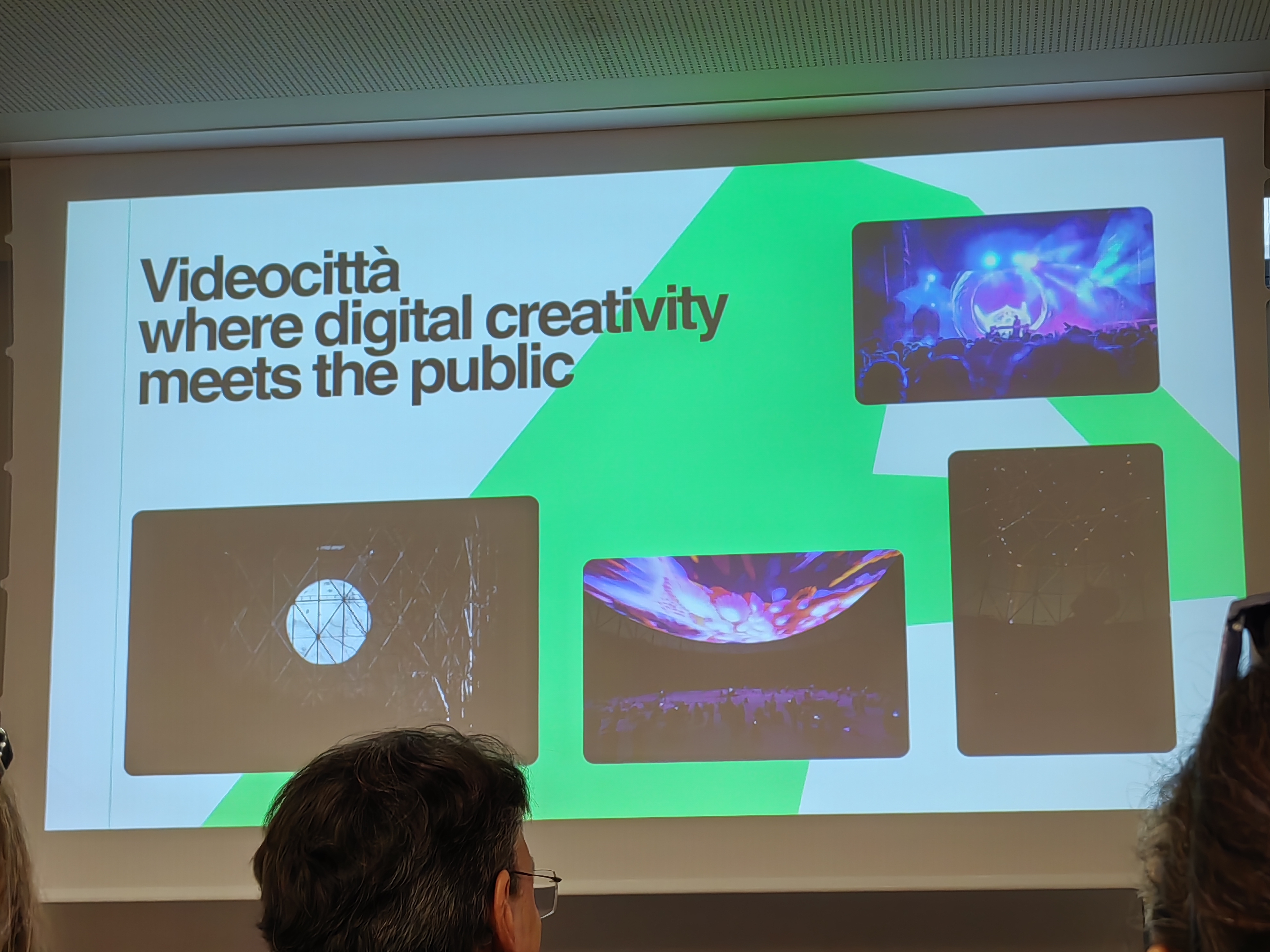
Two weeks ago, I received a message from Filippo, one of those encounters that have helped me find my way in Italian culture as I struggled - and continue to struggle - to recover from my unexpectedly shortened stay in China. He was inviting me to take part in Agora, one of the events held as part of Videocittà, the festival that brings leading figures from Italy’s digital creative scene and beyond to Rome each year. Still largely unfamiliar with the Italian landscape, I immediately saw it as an excellent opportunity to expand Virtual Africa’s network and agreed to submit my proposal.
So it was with a degree of surprise, but with even greater pleasure, that a few days later I learned my application had been accepted and received an invitation to join an event billed as a marketplace for digital creativity. Filippo got back in touch and we arranged to make the trip together. After a good hour on the road, we arrived at the Hilton in Rome’s EUR district, home to many of the city’s major administrative institutions. From there, we headed down to the conference room tucked away on the floor below.

The day’s programme unfolds in two parts. The first takes the form of a kind of speed-dating session, pairing us with representatives from organisations whose interests might resonate with our projects and open the door to further conversation. An excellent initiative, in my view. I am matched with Palacio Libertad/CCK (Argentina), the Festival of Lights (France), teamLab (Japan), the Doha Film Institute (Qatar), ArtScience Museum Singapore (Singapore), CODAworx (USA), and Creative Machines (USA). I come away genuinely pleased with the conversations I have had with their representatives, and hopeful that some of these initial encounters will grow into lasting exchanges and, ultimately, meaningful projects.
Other organisations were represented as well and, like every other participant, I found myself wishing we had been given more time, as the allotted ten minutes seemed to disappear almost instantly. It would also have been nice to meet more potential partners informally, over coffee or a meal. This was a change my companion for the day was quick to point out, noting that the previous edition had offered more opportunities for conviviality and exchange. This time, catering was left to individual arrangements and, as a result, people tended to disperse when we might all have benefited from spending more time together. To conclude on this point - as it speaks directly to the purpose of this endeavour - I must also note the striking, and revealing, absence of representatives from the African continent. Without claiming to be exhaustive, this absence raises questions of both representation and funding that I have no pretension of resolving here, but which nonetheless deserve to be raised.

The second part of the day was devoted to presentations of outstanding projects from Italy and abroad, selected by Videocittà. Alfredo Cramerotti opened the programme with the Media Majlis Museum, whose work sits at the intersection of journalism, design, and digital media. Beyond the projects presented, one element in particular stayed with me: a timeline tracing the rise of spaces devoted to the creation and circulation of new media practices across the Middle East, South Asia, and North Africa.

Takeshi Yamada from teamLab, whom I had spoken with just a few minutes earlier, followed with a presentation of some of the most striking projects by the renowned collective, widely known for its futuristic and immersive installations around the world. Two conceptual threads seem to run through its work: the transcendence of boundaries—between media, spaces, and beyond (see, for instance, the Borderless series)—and an engagement with environmental phenomena through the idea of continuums within living systems. The latter, to my mind, echoes certain lines of research into metamaterials, reminiscent of Kim Yunchul’s work.

In a more institutional vein, Phillip Dunlap spoke about the selection and funding processes behind projects supported by the Broward County Division in Florida, as well as its public art programme and, notably, Ignite, a festival it has organised since 2022 in collaboration with the creative agency and immersive art museum MAD Arts.

Myriam Achard then introduced us to the impressive history and vision of PHI Contemporary, which, through its network of venues - particularly across North America and Europe - works across contemporary art, live performance, and digital practices. I took note of her recommendations for Carne y Arena by Alejandro G. Iñárritu, created in collaboration with Emmanuel Lubezki and Blur, The Promise of Immortality by Craig Quintero and Phoebe Greenberg - two immersive works combining installation, performance, and virtual reality.


To conclude this series of presentations on outstanding international projects, Fahad Al Obaidly, director of the Design Doha biennale, invited us to its opening on 5 November and shared the broader philosophy driving the initiative: “translating knowledge from ancestral systems to economic futures.” He emphasized the need to transform regional knowledge, cultures, and traditions across MENASA into new opportunities for research and innovation.

One of the presentations that struck me most was that of Fulvia Carnevale, the feminist conceptual artist behind Claire Fontaine, the duo she forms with James Thornhill, whose work Foreigners Everywhere lent its title to the 2024 Venice Biennale. In her talk, Fulvia Carnevale outlined some of the conceptual concerns that shape their practice, engaging with issues of appropriation, (in)visibility, and the technologies of subjectivization. I hope to have the opportunity to visit their studio in Sicily someday and continue the discussion we started.


Mattia Carretti of Fuse then introduced us to Luna Somnium, a series of monumental works that, in some ways, bring Olafur Eliasson’s The Weather Project to mind, though with a more industrial, structural, and metallic aesthetic - somewhat in the spirit of Tinguely. A truly beautiful achievement. It was also an opportunity to learn that Johannes Kepler is credited with writing what is often considered the first work of science fiction, Somnium, in 1609.

Serial investor and project developer Alfredo Dammo introduced us to Re:Humanism, a platform dedicated specifically to initiatives exploring the challenges and possibilities of creative practice in the age of artificial intelligence, which he is developing alongside Matèria gallery, Fondazione Pastificio Cerere, and Roma Europa Festival.

Anna Lea Antolini, this year’s artistic director of Videocittà, and Guido Geminiani then joined forces to share their respective perspectives on the work of Impersive, a studio producing immersive films that were displayed through the virtual reality headsets installed in the hotel’s lower corridor. Beyond advertising campaigns for various brands and luxury houses, the discussion focused primarily on the studio’s involvement in the European programme Co-Vision: Mapping Europe’s Natural Heritage in Digital Archives.


Finally, to bring the day to a close, Julien Poncelet and Antonio Abete reflected on the production work of Filmmaster, a major Italian event production company with operations in Saudi Arabia, where they coordinate Noor Riyadh, the city’s festival of light.


I would have liked to spend more time speaking with each of these people - and with others I have not mentioned here - but the programme was already remarkably dense. It was time for us to step outside, get some air, and settle on a terrace to reflect on the day and the conversations we had had. Further workshops were scheduled for the following day, while the festival itself would continue throughout the weekend across several venues in the capital. Unable to attend because of other commitments, I promised myself that next time I would plan better and return for the following edition.
Thank you, Filippo.